
Plastic and aesthetic surgery practices across the U.S. continue to operate in a stable but increasingly complex environment, according to Paradigm Search Group’s latest Practice Production and Operational Benchmarking Survey.
Drawing on insights from practices nationwide, the data points to a market defined by steady growth with consistency, operational discipline, and strategic decision-making. Compared to Paradigm’s 2024 survey, this year’s findings reflect notable continuity across key metrics, highlighting a market that is maintaining growth with increasing focus on efficiency, staffing, and sustainability.
“What stood out to us this year wasn’t necessarily dramatic change, but the consistency of the themes practices continue to face,” says Steve Look, CEO of Paradigm Search Group. “Demand remains healthy, but many surgeons and practice leaders are clearly focused on operational efficiency, staffing, and sustainable growth strategies rather than rapid expansion.”
Steady demand defines the market
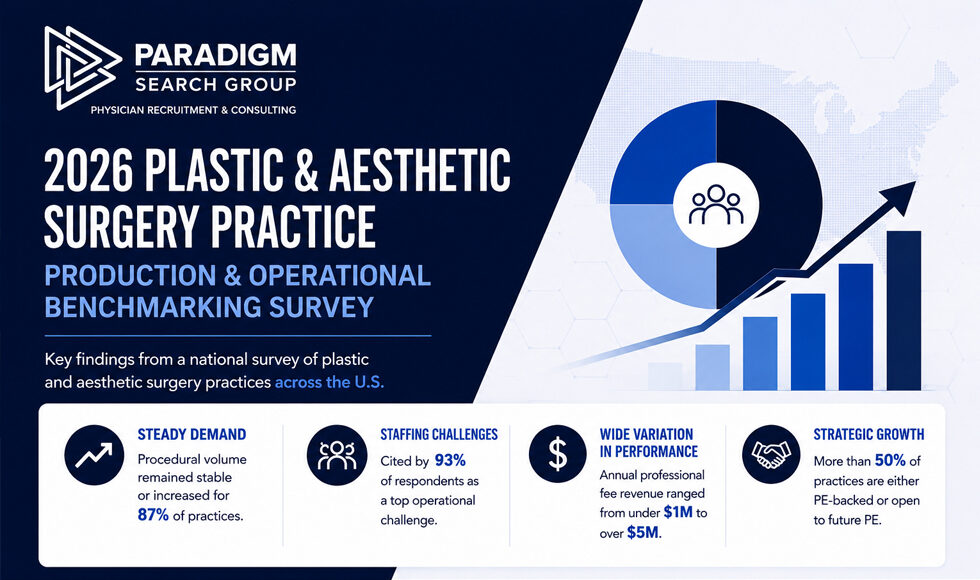
Survey responses suggest procedural demand remained steady across many practices in 2025. Respondents reported maintaining consistent surgical volume levels throughout the year, reflecting continued patient interest in both aesthetic and reconstructive procedures.
While these figures do not point to explosive growth, they reinforce a pattern first observed in 2024: demand remains strong but has largely stabilized at consistent levels. The data suggests many practices exist in a more normalized operating environment after several years of unusually elevated growth.
Most respondents also reported operating in suburban or major metropolitan markets, reinforcing the continued concentration of plastic and aesthetic surgery demand in higher-population growth areas.
An experienced, physician-led field
The majority of respondents represent established practices with more than 16 years in operation, while most continue to operate as private, physician-owned groups.
This mirrors findings from 2024 and reinforces the role of experienced physician owners and operators in navigating evolving patient expectations, economic pressures, and changing market dynamics. The continued prominence of these practices reflects a sector defined by stability, operational experience, and long-term strategic planning.
“Demand remains healthy, and many surgeons and practice leaders are clearly focused on operational efficiency, staffing, and sustainable growth strategies.” -Steve Look, CEO
Operational challenges persist
Despite steady patient demand, practices continue to face meaningful operational pressures. Staffing remains a key focus, particularly recruiting and retaining non-physician staff, and persists as one of the most frequently cited challenges, alongside patient acquisition and broader economic factors such as inflation and shifts in discretionary spending.
Staffing and recruitment was cited by 93% of respondents as a significant operational challenge, followed by rising operating costs (67%) and marketing and patient acquisition pressures (40%).
Notably, these challenges closely align with those reported in 2024, suggesting they are not short-term disruptions but ongoing structural realities shaping the industry.
For many practices, patient demand is consistent such that staffing often appears to be a primary limiting factor to growth. Even practices with healthy patient volume may struggle to scale efficiently without experienced clinical and operational support teams in place.
“One of the most interesting takeaways is that patient demand doesn’t appear to be the biggest challenge right now,” Look says. “For many practices, the greater challenge is building the infrastructure and staffing support necessary to grow efficiently in a competitive market.”
Practice leaders also appear to be taking a more measured operational approach overall, focusing on efficiency, retention, and long-term sustainability rather than aggressive expansion at all costs.
Wide variation in financial performance
Survey responses reveal significant variability in both revenue and compensation, with practices reporting a broad range of annual production and income levels, from under $1 million to more than $5 million in annual professional fee revenue.
This pattern is consistent with prior findings and highlights the diverse ways practices are structured and scaled, as well as differences in service mix, efficiency, and market positioning. Rather than a uniform financial model, the data reflects a spectrum of performance across the industry.
Survey responses also reinforce the growing importance of non-surgical revenue streams, including injectables, laser treatments, and skin care services, as practices continue to diversify services and optimize revenue opportunities.
Measured approach to growth
While many practices are considering expansion, including recruiting additional surgeons or exploring private equity opportunities, responses suggest a cautious, strategic approach rather than aggressive growth.
More than half of respondents reported either existing private equity involvement or openness to future PE partnerships, signaling continued interest in strategic growth and consolidation opportunities.
This measured outlook mirrors sentiment from 2024, reinforcing the idea that practices are prioritizing sustainable growth and long-term planning for measured expansion.
“Practices are clearly operating with greater awareness of economic pressures than they were a few years ago,” Look says. “That doesn’t mean demand has disappeared. It means owners and leaders are operating more thoughtfully and strategically.”
Growth remains relationship-driven
Patient referrals, physician referrals, and digital marketing strategies such as social media and SEO continue to rank among the most commonly utilized growth strategies among respondents.
This hybrid approach reflects the continued importance of reputation and relationships alongside modern marketing tools, rather than a wholesale shift toward digital-only strategies. The findings suggest that while digital visibility is increasingly important, trust and word-of-mouth referrals remain foundational drivers of long-term growth.
What this means
Taken together, the findings suggest that plastic surgery practices are operating in a “steady-state” environment, characterized by reliable demand but ongoing pressure to optimize operations, staffing, and financial performance.
The consistency between this year’s data with that of prior years points to a maturing, stabilizing market, where success is steady and focused on operational efficiency, strategic decision-making, and the ability to adapt within a competitive landscape.
The findings suggest the industry remains fundamentally healthy, though increasingly dependent on operational execution rather than demand alone.